
History of Mental Health
Time Article Summary
“For millennia we have wrestled with mental illness - first to understand it and only later to treat it”, began a recent Time Special Edition entitled, Mental Health — New Understanding. From the moment we became a self-aware species, we’ve struggled to understand why the distinct internal worlds of some are so much less joyful than others. From the early answers from Aristotle and Hippocrates to 17th century lunatic asylums to Freud’s discovery of the unconscious mind to talk therapy and sophisticated drugs like lithium, we have missed the mark. The 2019 Time edition concluded that we were “slowly driving it into retreat”.
However, systematic tracking of youth mental illness in the United States began in the mid-1990s, with Federal Surveillance tracking rates from 1994 onward. Mental illness, particularly youth mental illness, has seen an alarming surge over the last decade, with 1 in 3 youth aged 12 to 17 experiencing a behavioral or mental health issue, including clinical depression, anxiety, and self-harm. Most foundations and agencies attribute this surge to the proliferation of digital devices, academic pressures, and post-pandemic disruptions. Some researchers include the effects of Great Recession (2007-2009) and caregiver mental health (loss of parents due to drug overdoses and firearms) as the strongest predictor.
Stress lives on a continuum between “who we are” and “who we pretend/strive to be”. Living in between, and especially near the later endpoint can lead to identity stress and mental illness. Some believe that affluent youth are less subject to the factors leading to mental illness because they have greater access to structured activities, leaving less idle time to find trouble. While data clearly shows higher rates of anxiety, depression, and suicidal risk among adolescent youth living in poverty, unstable housing, and limited care access, affluent youth are also experiencing a mental health crisis (substance use, internalizing problems, pressure, isolation, and peer influences). While all these factors can impact mental health, data has not demonstrated that the removal of any of these factors in isolation will cause the surge to leveled off or decline.
We attribute the youth mental health crisis to everything and everyone, except ourselves. The neuroscience that supports identifying trauma correlation factors and triggers are certainly meaningful in treatment of youth experiencing mental health crises. Our professions of therapy, psychiatry, and dozens of holistic modalities are of great service in trauma management, but without the ability to alter, remove, or offset these identified factors in our society, the idea of leveling off and reversing the troubling upward trends of our current youth mental health crisis is merely an illusion.
Clearly, our society is designed to drive youth toward the “who we pretend/strive to be” spectrum endpoint. It begins at, and sometimes before, birth. We play music and read to the unborn fetus. We name our children after ourselves and immediately begin coaching them to become all the things we dreamt of, but have yet to achieve in our own lives. We insist on them adopting our religious, political, and social beliefs. Then, we place them into structured systems of education that lead to the same 40-year work cycle that we regularly complain about. Finally and usually, once we have transitioned, they retire with declining energy, health, and enthusiasm to watch the same cycle repeat itself.
When a child is born with a brilliance or drive that does not fit within this framework, we work hard to correct their misguided souls, so that they can enjoy a “normal” life — the same one we look back upon with regret.
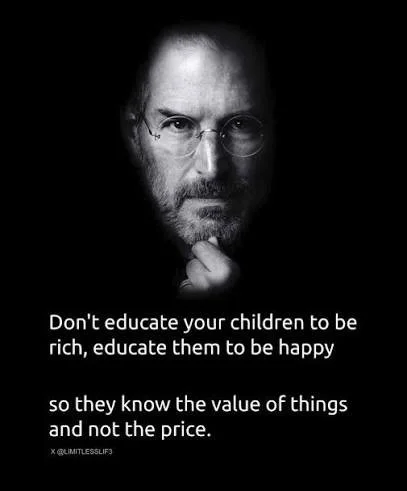
Instead of offering unconditional love and supportive guardrails, we offer or force corrective and often smothering guidance. In today’s society, despite the counsel of the likes of Steve Jobs, from his dying bed, we continue to educate our children to become rich, rather than happy. When the child is wired by the Universe to be “who they are”, but parents and societal norms drive them toward a different place, the child either responds with efforts to dismiss their sincerity in an effort to conform or they are labeled difficult and stubborn, due to their resistance to parental and societal primacy. Both can place the child in a state of overwhelming friction, or stress, forming the foundation for mental illness.
A seed requires no guidance to become a tree. A tree requires no guidance to produce oxygen. A birds requires no guidance to fly effortlessly. A fish requires no guidance to swim. Clouds require no guidance on when to release moisture back to the earth. We trust nature for ecological guidance in all aspects of life, and so far, it has done an exceptional job. However, we do not trust it with our children. With parenting, we tend to be control enthusiasts, compelled to provide both offspring guardrails AND precise micromanagement on how our children should “be”. Perhaps it is this thirst for control, framed as loving and expected guidance, that must begin accepting at least partial responsibility for creating the widespread and increasing stress that sits at the foundation of our ongoing and worsening youth mental illness crisis.
Despite the 2019 Time Special Edition claims, data indicates that not only are we not “driving it into retreat,” but we have regressed to the point where the World Health Organization, Center for Disease Control, Annie E. Casey Foundation, and most other respected organizations admit that we are currently facing a global mental health crisis, with no leveling off or decline in sight.
Paradigm Shift
The United States federal government annually spends billions of dollars ($42 billion in 2022) on youth mental health, yet the associated crisis has worsened in the last decade. With 40% of high school students reporting persistent feelings of sadness or hopelessness in 2023, Most indicators suggest that a fresh approach might be worth consideration. Honoring the gap in values between today’s youth and societal leadership is a natural starting point.
Data indicates that the pervasive notion of dreams deferred is an eroding value among today’s youth. Many youth have simply outgrown the traditional beliefs that dream college education, religious faith, and traditional marriage are pathways to eternal happiness. Among youth, college enrollments have declined since 2010; religious unaffiliation outnumbers Christians; and cohabitation and alternative lifestyles have overtaken traditional heterosexual marriage.
If we focus on only on eduction, we note that Yale research reveals 75% of students reporting negative feelings of stress and boredom toward toward their current high school experiences. While the idea of dream college still exists for some, many youth see it as an opportunity to continue the stress experienced in high school and only a dream for their parents. The promise that a top college degree will guarantee a fulfilling and lifelong career of happiness has been shattered by the reality of student loans, fear of continuing their negative high school experience, AI job displacement, and watching while 85% of their parents feeling disengaged with or hating their jobs.
When a society requires youth to enjoy values that they they do not share, internal conflict and stress arises. With this in mind, we must admit that today's youth mental health pandemic is not surprising. Professional treatment, in-school therapy, and awareness workshops can be of some value, but if we truly expect todays youth to thrive while being smothered by unshared and outdated societal values, perhaps the wrong audience is receiving mental health support.
Due to shifting generational values, the solution to the youth mental health pandemic and the post-high school education/work dilemma rests just beyond our egos, in the the acknowledgment that what youth want today varies from the desires of previous generations. Youth mental health awareness, diagnosis, and treatment touches the very small segment of the population that acknowledges the need for help or shows symptoms. It does little in the way of prevention to effectively address or diminish the inward flow of those with evolving challenges. So, noble intentions and large budgets are invested in an exercise of whack-a-mole.
In 1903, the General Education Board was tasked with developing a nation of workers that would obey authority; follow rules; memorize (not think); and work 9-5 jobs for elite companies to meet the demands of the Industrial Revolution. Higher education and degrees from prestigious colleges gave citizens a competitive edge when entering the workforce, but has been unable to guarantee less stress or true feelings of personal success. In today’s Digital Information Age, youth values have become more self-serving, with a shift towards independent thought, innovation, creativity, self-expression and personal passion.
Acknowledging that there is a difference between youth delivering passion to the lives of their parent’s versus themselves puts us in position to win. Most parents would love to boast that their child is an Ivy League student —so much that an entire industry has been created to supply this demand. However, while most students would love to please their parents, many acknowledge that an ivy league education is their parent’s dream, not their own. When asked what brings them true passion, many youth admit that it is not attending an ivy league college, nor any other college. When pressed, very few reveal that they have ever even given much thought to their true personal passion. Rather, like their parents did, they believe they MUST attend college, get a good job, work for 40 years, and retire before they can even think about their personal passion.
When we encourage our youth to discover and unapologetically accept and live with who they are, we reduce the daily conflict that feeds their stress. Subsequently, mental illness starves without a healthy supply of this stress on which to feed. While awareness, diagnosis, and treatment are wonderful tools to identify and address mental illness, true prevention requires the removal of the core conflict.
If, as a parent, you think you know more about what will bring your child true passion than they do, please stop reading and close this page now. If you are still reading, congratulations, because you highly value your child’s true passion and are a part of a growing adult segment of … youth mental health pandemic abolitionist!